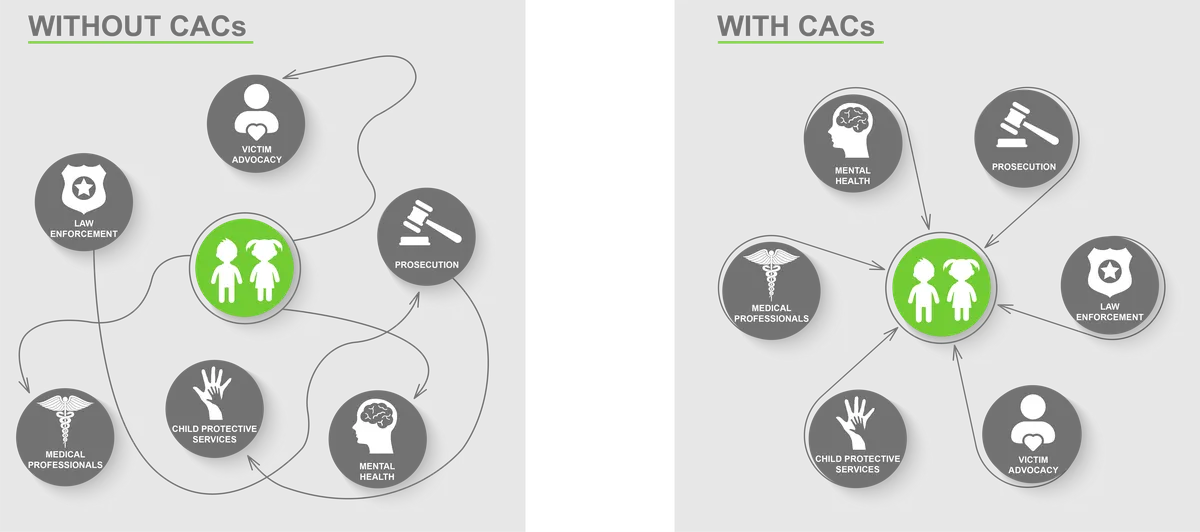
The CAC Model
A child-friendly place where the agencies responding to abuse work as one team.
What is a Children’s Advocacy Center?
When police or child protective services believe a child may be experiencing abuse, the child is brought to a Children’s Advocacy Center — a safe, child-focused environment — by a caregiver or other safe adult.
At the CAC, the child tells their story once to a trained interviewer who knows the right questions to ask in a way that does not re-traumatize the child. A team that includes medical professionals, law enforcement, mental health practitioners, prosecution, child protective services and victim advocacy then makes decisions together about how to help the child, based on that interview.
This is called the multidisciplinary team (MDT) response, and it is the core of what CACs do.
Why it matters
Without a CAC, a child may be interviewed many times in many places — a police station, a hospital, a school office — repeating the worst experience of their life to a series of strangers. Each retelling risks further harm and can weaken the case against the person who hurt them.
With a CAC, the agencies come to the child instead.
What a CAC provides
- A forensic interview conducted once, by a trained professional, in a child-friendly room
- Medical evaluation and treatment
- Trauma-focused mental health services for the child and their non-offending family members
- Victim advocacy and case management
- Courtroom preparation and support
- Coordination between every agency involved in the case